Raksha Bandhan 2026
Raksha Bandhan 2026 – Date, Shubh Muhurat, Bhadra, Puja Vidhi & Mantra
Friday, 28 August 2026 · Shravan Purnima
Raksha Bandhan 2026 falls on Friday, 28 August 2026, on Shravan Purnima. The rakhi should be tied while the Purnima tithi is running and only after Bhadra has ended. Because sunrise and sunset differ from city to city, the usable window also differs — use the city selector below for your local timings.
City-wise Rakhi Muhurat
Purnima tithi
27 Aug, 09:09 am — 28 Aug, 09:49 am
Bhadra (Vishti karana)
27 Aug, 09:09 am — 27 Aug, 09:33 pm
Sunrise
06:04 am
Sunset
06:51 pm
Nakshatra at sunrise
Shatabhisha
Aparahna window
Not available — Purnima ends before aparahna, so tie the rakhi in the morning.
Rakhi muhurat (Bhadra-free Purnima)
28 Aug, 06:04 am — 28 Aug, 09:49 am
Muhurat varies by city. All times are shown in Indian Standard Time (IST) and are computed for your selected city.
Date & the shastriya decision
Raksha Bandhan is observed on Shravan Purnima. When the Purnima tithi spans two civil days, the shastras place the ritual on the day when Purnima is present during the daytime and Bhadra is over — normally the aparahna (afternoon) period, and where that is unavailable, the available Bhadra-free daytime portion of Purnima.
For 2026, Purnima is present on the morning of Friday, 28 August, and Bhadra has already ended on the previous evening. The festival is therefore observed on 28 August 2026.
Shravan Purnima
Shravan Purnima is the full-moon day of the Shravan month, the most sacred month for Lord Shiva. The same tithi carries Upakarma (Janeu Purnima), Narali Purnima on the western coast and Kajari Purnima in parts of north India.
Purnima represents completeness. A protective thread tied on this day is believed to carry the strength of a full lunar cycle behind the sankalp.
Bhadra and why it matters
Bhadra is Vishti karana — one of the eleven karanas, personified in the puranas as the daughter of Surya and sister of Shani. Auspicious beginnings such as tying the raksha sutra, marriage rituals and grih pravesh are traditionally avoided during Bhadra.
The scriptural caution comes from the Ramayana tradition, where Shurpanakha is said to have tied a rakhi to Ravana during Bhadra. Whatever the account, the practical rule is simple and universally followed: wait for Bhadra to end, then tie the rakhi.
Bhadra always occupies a fixed half of certain tithis, so its timing is calculated, not guessed. The panel above shows the computed Bhadra period for 2026 along with the clean window that follows it.
Rakhi puja vidhi — step by step
- 1Bathe early, wear clean traditional clothes and clean the puja space.
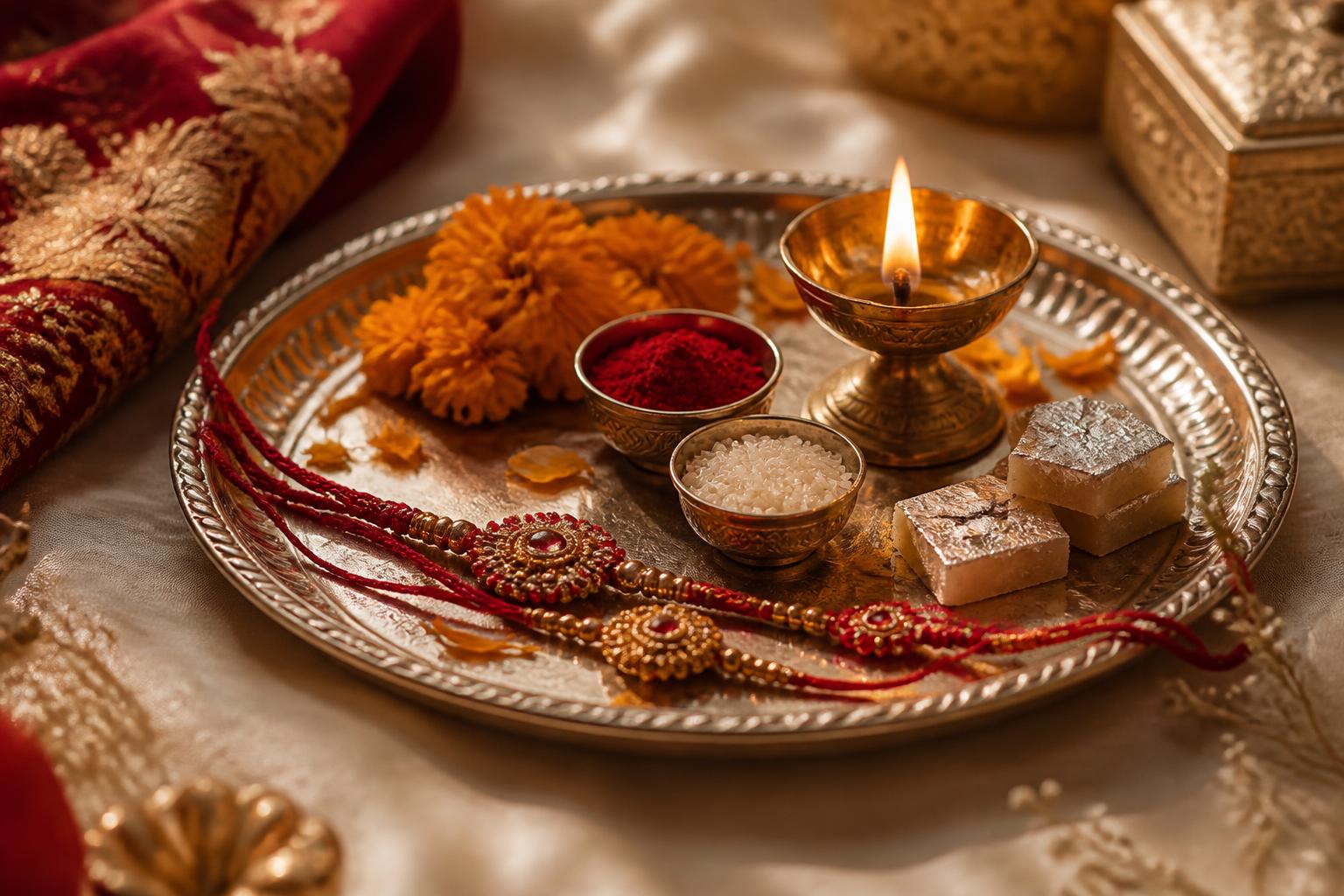
- 2Prepare the thali: roli or kumkum, unbroken akshat (rice), a diya, sweets, the rakhi and a little water.
- 3Offer the first rakhi to your family deity or to a picture of Lord Ganesha and pray for protection.
- 4The sister faces the brother; the brother sits facing east or north.
- 5Apply tilak with roli, press akshat on the tilak and perform aarti with the lit diya.
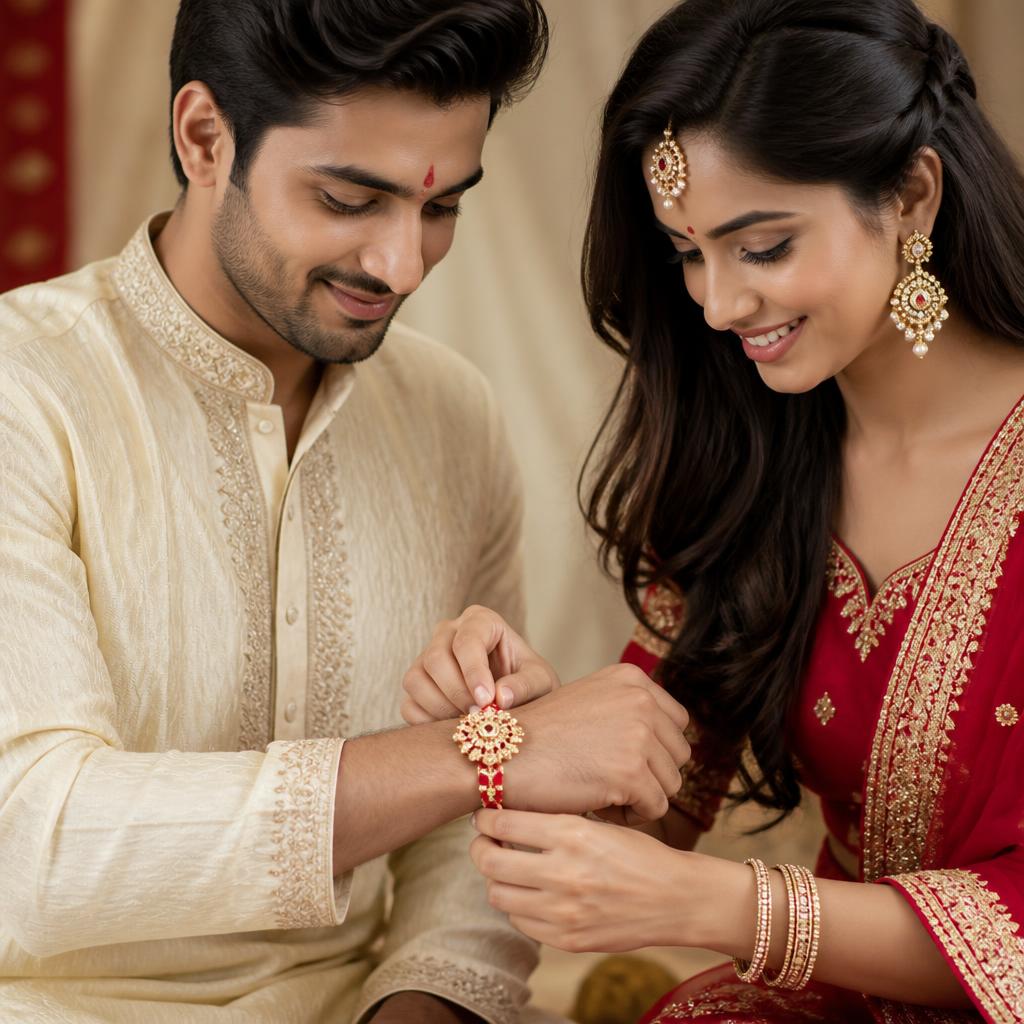
- 6Tie the rakhi on the brother's right wrist while reciting the Raksha mantra.
- 7Offer sweets, take blessings from elders, and the brother gives a gift or dakshina.
- 8Complete the ritual within the Bhadra-free Purnima window shown for your city.
Puja thali samagri
- Rakhi / raksha sutra
- Roli or kumkum
- Unbroken akshat (rice grains)
- Ghee diya and cotton wick
- Incense (dhoop or agarbatti)
- Sweets or mishri
- Small kalash of clean water
- Coconut or dry fruits
- Fresh flowers
- A clean cloth for the thali
Traditional Raksha mantra
येन बद्धो बली राजा दानवेन्द्रो महाबलः। तेन त्वामनुबध्नामि रक्षे मा चल मा चल॥
Yena baddho balī rājā dānavendro mahābalaḥ. Tena tvām anubadhnāmi rakṣe mā chala mā chala.
Meaning in simple words: 'The same protective thread that once bound the mighty king Bali, lord of the danavas, I now tie upon you. O raksha, remain steady, do not move.' It is a prayer that the protection stays with the wearer.
Recite it once while tying the thread. If you cannot pronounce the Sanskrit, saying the prayer for protection in your own language with faith is accepted.
Spiritual significance
Raksha Bandhan is not only a brother–sister festival. The raksha sutra is a sankalp of protection — a promise given, and divine grace invoked to keep it.
The thread is tied on the right wrist because the right side is associated with action and dharma. Traditionally the same thread is worn until it falls away on its own, and is then immersed in water or placed under a tree rather than thrown in the bin.
Traditional dos & don'ts
Traditional dos
- Tie the rakhi only after Bhadra ends and while Purnima is running.
- Face east or north during the ritual.
- Use unbroken rice grains for the tilak.
- Keep the sankalp of protection sincerely in mind while tying.
- Touch the feet of elders and take their blessings afterwards.
Traditional don'ts
- Do not tie the rakhi during Bhadra.
- Do not use a black thread as the raksha sutra.
- Do not use broken rice or a broken diya in the thali.
- Do not throw the old rakhi in the dustbin — immerse it respectfully.
- Avoid arguments and non-satvik food on the day of the ritual.
Rashi-wise raksha sutra colours
Traditional Astrological Guidance — this is customary practice followed by many families and astrologers, based on the lord of each rashi. It is a helpful convention, not an absolute shastric rule. Any clean, respectfully tied rakhi is complete in itself.
Mesha (Aries) · मेष
Raksha sutra colour
Red or orange
Ruled by Mangal. Offer jaggery-based sweets and keep the ritual calm and unhurried.
Vrishabha (Taurus) · वृषभ
Raksha sutra colour
White or silver
Ruled by Shukra. A silver-threaded rakhi and kheer as prasad are traditionally favoured.
Mithuna (Gemini) · मिथुन
Raksha sutra colour
Green
Ruled by Budh. Donating green moong or a book after the ritual is a customary addition.
Karka (Cancer) · कर्क
Raksha sutra colour
White or pearl
Ruled by Chandra. Offering white sweets or rice kheer suits this rashi's temperament.
Simha (Leo) · सिंह
Raksha sutra colour
Golden or saffron
Ruled by Surya. Perform the tilak facing east and offer water to the Sun before the ritual.
Kanya (Virgo) · कन्या
Raksha sutra colour
Green
Ruled by Budh. Keep the thali neatly arranged; precision in the vidhi suits this rashi.
Tula (Libra) · तुला
Raksha sutra colour
White or light pink
Ruled by Shukra. A fragrant rakhi with fresh flowers in the thali is traditionally advised.
Vrishchika (Scorpio) · वृश्चिक
Raksha sutra colour
Red or maroon
Ruled by Mangal. Reciting Hanuman Chalisa after the ritual is a commonly followed practice.
Dhanu (Sagittarius) · धनु
Raksha sutra colour
Yellow
Ruled by Guru. A yellow thread with a chana dal or besan sweet offering is preferred.
Makara (Capricorn) · मकर
Raksha sutra colour
Deep blue or dark grey
Ruled by Shani. Feeding a needy person or a stray animal after the ritual is customary.
Kumbha (Aquarius) · कुम्भ
Raksha sutra colour
Blue
Ruled by Shani. Donating black sesame or mustard oil on this day is a traditional remedy.
Meena (Pisces) · मीन
Raksha sutra colour
Yellow or golden
Ruled by Guru. Offering haldi-tinged akshat and yellow sweets is the customary choice.
Traditional gift & remedy guidance
- A gift given with respect is part of the ritual — silver, sweets, clothing or something useful is traditionally preferred over sharp objects.
- Avoid gifting knives, scissors, black clothing, footwear or empty wallets; put a coin or note inside a wallet if you gift one.
- Donating food, clothes or a small amount at a temple on Purnima is considered to strengthen the protection invoked.
- Feeding cows and offering water to the Peepal tree on Shravan Purnima are simple, widely followed remedies.
- For a family member facing a difficult planetary period, a personalised remedy is better decided after seeing the birth chart.
2026 festival & astrology notes
- Raksha Bandhan 2026: Friday, 28 August 2026 (Shravan Purnima).
- The same tithi is observed as Shravani Upakarma, Narali Purnima and Kajari Purnima in different regions.
- Bhadra ends on the previous evening in 2026, so the whole Purnima portion of 28 August morning is clean for tying the rakhi.
- Purnima ends in the forenoon on 28 August, so an early ritual is advised rather than an afternoon one.
- All timings on this page are computed from an astronomical ephemeris for your selected city and shown in IST.
Frequently asked questions
When is Raksha Bandhan in 2026?
Raksha Bandhan 2026 is on Friday, 28 August 2026, the day of Shravan Purnima.
What is the shubh muhurat for tying the rakhi in 2026?
The rakhi should be tied while Purnima is running and after Bhadra has ended. Since sunrise differs by city, use the city selector on this page for your local window; in 2026 the usable period falls in the morning of 28 August because Purnima ends in the forenoon.
Why should rakhi not be tied during Bhadra?
Bhadra is the Vishti karana, traditionally considered inauspicious for beginnings and protective rituals. The shastras advise waiting until Bhadra ends before tying the raksha sutra.
Is Bhadra a problem on 28 August 2026?
No. Bhadra ends on the evening before, so the Purnima period available on the morning of 28 August 2026 is free of Bhadra.
Can rakhi be tied after Purnima ends?
The ritual is meant to be performed within the Purnima tithi. If that is not possible, tie it with a sincere prayer as soon as you can — the sankalp of protection matters most.
Which colour rakhi should I choose for my rashi?
Many families follow the colour associated with the lord of the rashi — for example red for Mesha and Vrishchika, green for Mithuna and Kanya. This is traditional guidance, not a compulsory rule.
Can a sister tie rakhi to a sister, or a wife to a husband?
Yes. The raksha sutra is a bond of protection and has traditionally been tied by priests to patrons and by family members to each other, not only between brother and sister.
What should be done with the rakhi afterwards?
Wear it until it comes off naturally, then immerse it in flowing water or place it respectfully under a tree instead of discarding it.
Share this guide
Explore more
Speak with Acharya Vishnu Kumar Sharma
For a personalised muhurat, a family remedy or guidance based on your own birth chart, book a consultation with Acharya Vishnu Kumar Sharma.